Famous games
A thirteen-year-old gives up his queen, and the room goes quiet.
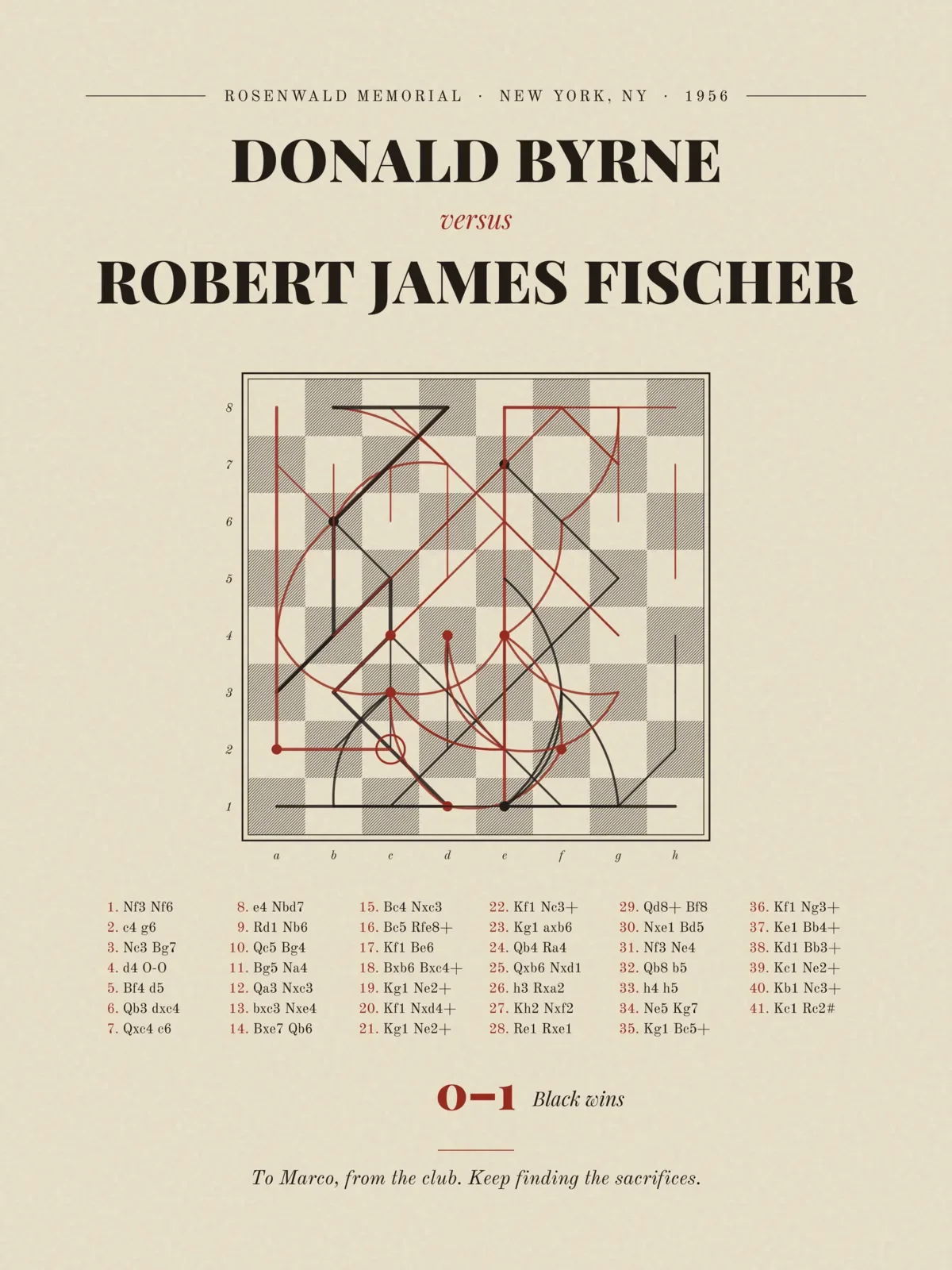
Donald Byrne was one of the strongest players in the United States. Bobby Fischer was in the eighth grade. On move seventeen the boy left his queen to be taken, and twenty-four moves later it was Byrne's king that was mated. The print has eighty-two half-moves on it, and you can see the whole hunt.
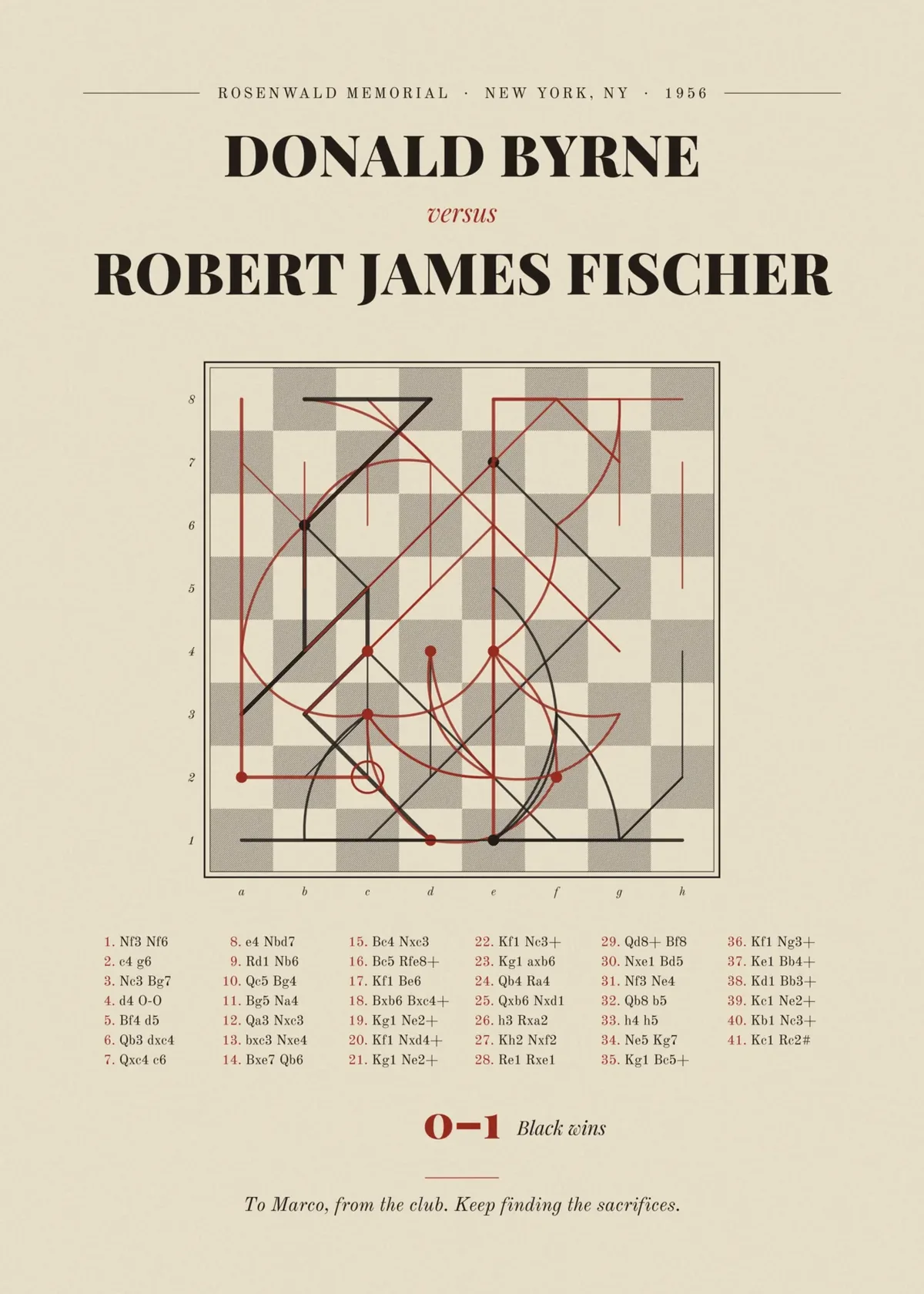
The game was played in the eighth round of a small invitational in a chess club in Manhattan, in October 1956. Byrne, twenty-six, had won the US Open three years earlier. Fischer, thirteen, had a draw against him from the year before and not much else anyone had noticed. The opening was quiet for ten moves. On the eleventh Byrne put his bishop on g5, a normal-looking move, and Fischer answered by sending a knight to the edge of the board, to a4, where it had no business being. It was the start of a combination that ran to the end of the game.
Six moves later came the move the game is named for. With his queen attacked, Fischer did not move it. He played his bishop to e6 and let Byrne take the queen. What he got for it was a rook, two bishops and a pawn, collected by a series of discovered checks that walked Byrne’s king back and forth between f1 and g1 while the knight ate what it liked. Hans Kmoch, writing it up for Chess Review, called it the game of the century, and wrote that for a boy of thirteen against an opponent of Byrne’s class it had no equal among the games of prodigies. The name stuck.
The rest is a hunt. Byrne’s queen was left on one side of the board, alone, while Fischer’s rook, bishops and knight closed in on the other. The story goes that Byrne played the last moves out so the people watching could see the mate, and it is worth seeing: the king is driven from g1 along the back rank to c1, each move a check, and the rook lands on c2. On the print the lines of that last walk are the short ones along the bottom edge; the long ones, across the whole board, are the bishops. A little over a year later Fischer was champion of the United States, at fourteen.
A queen for a rook, two bishops and a pawn. Then every one of those pieces was used, and the king walked from g1 to c1 to be mated.
The moves
- 1. Nf3 Nf6
- 2. c4 g6
- 3. Nc3 Bg7
- 4. d4 O-O
- 5. Bf4 d5
- 6. Qb3 dxc4
- 7. Qxc4 c6
- 8. e4 Nbd7
- 9. Rd1 Nb6
- 10. Qc5 Bg4
- 11. Bg5 Na4
- 12. Qa3 Nxc3
- 13. bxc3 Nxe4
- 14. Bxe7 Qb6
- 15. Bc4 Nxc3
- 16. Bc5 Rfe8+
- 17. Kf1 Be6
- 18. Bxb6 Bxc4+
- 19. Kg1 Ne2+
- 20. Kf1 Nxd4+
- 21. Kg1 Ne2+
- 22. Kf1 Nc3+
- 23. Kg1 axb6
- 24. Qb4 Ra4
- 25. Qxb6 Nxd1
- 26. h3 Rxa2
- 27. Kh2 Nxf2
- 28. Re1 Rxe1
- 29. Qd8+ Bf8
- 30. Nxe1 Bd5
- 31. Nf3 Ne4
- 32. Qb8 b5
- 33. h4 h5
- 34. Ne5 Kg7
- 35. Kg1 Bc5+
- 36. Kf1 Ng3+
- 37. Ke1 Bb4+
- 38. Kd1 Bb3+
- 39. Kc1 Ne2+
- 40. Kb1 Nc3+
- 41. Kc1 Rc2#
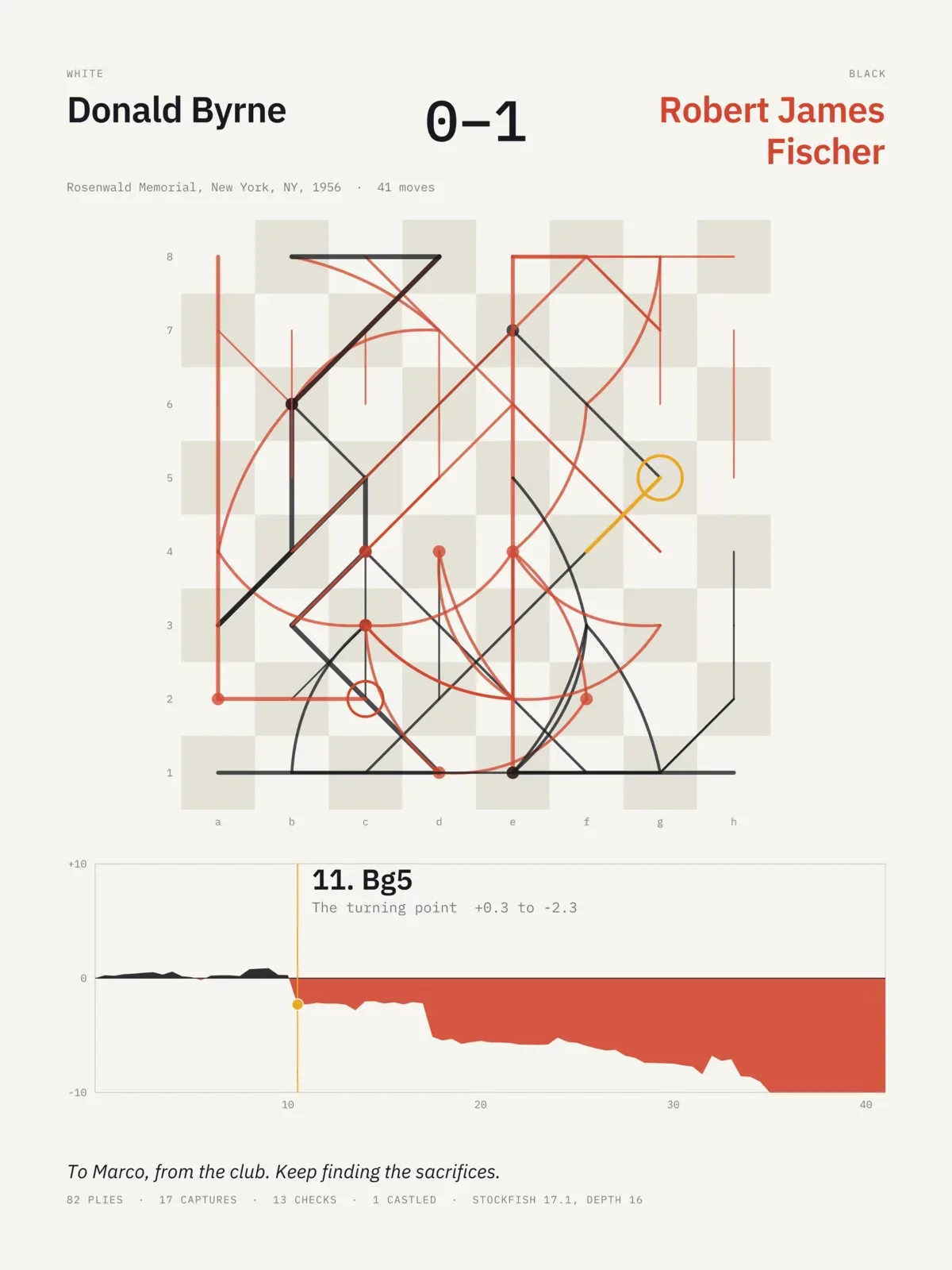
The turning point: 11. Bg5
The engine marks White's eleventh move, the bishop to g5, as the one after which the evaluation drops and never recovers. It is a natural move, and it loses: the reply, 11...Na4, is the one everybody remembers, and from there the knight, the bishops and finally the rook take the game apart. On the Data story print this is the move named on the chart; in the film it is where the score changes.
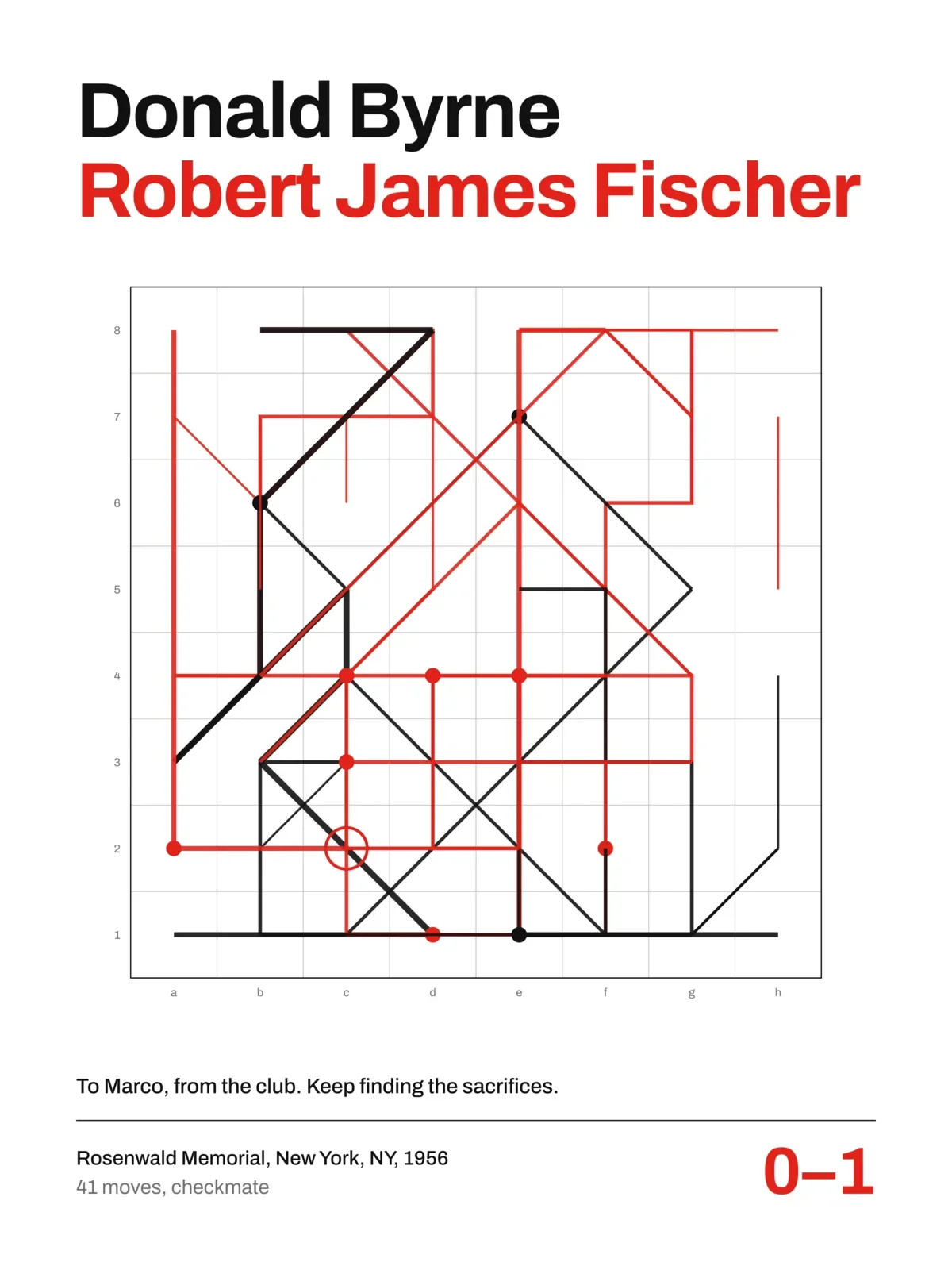
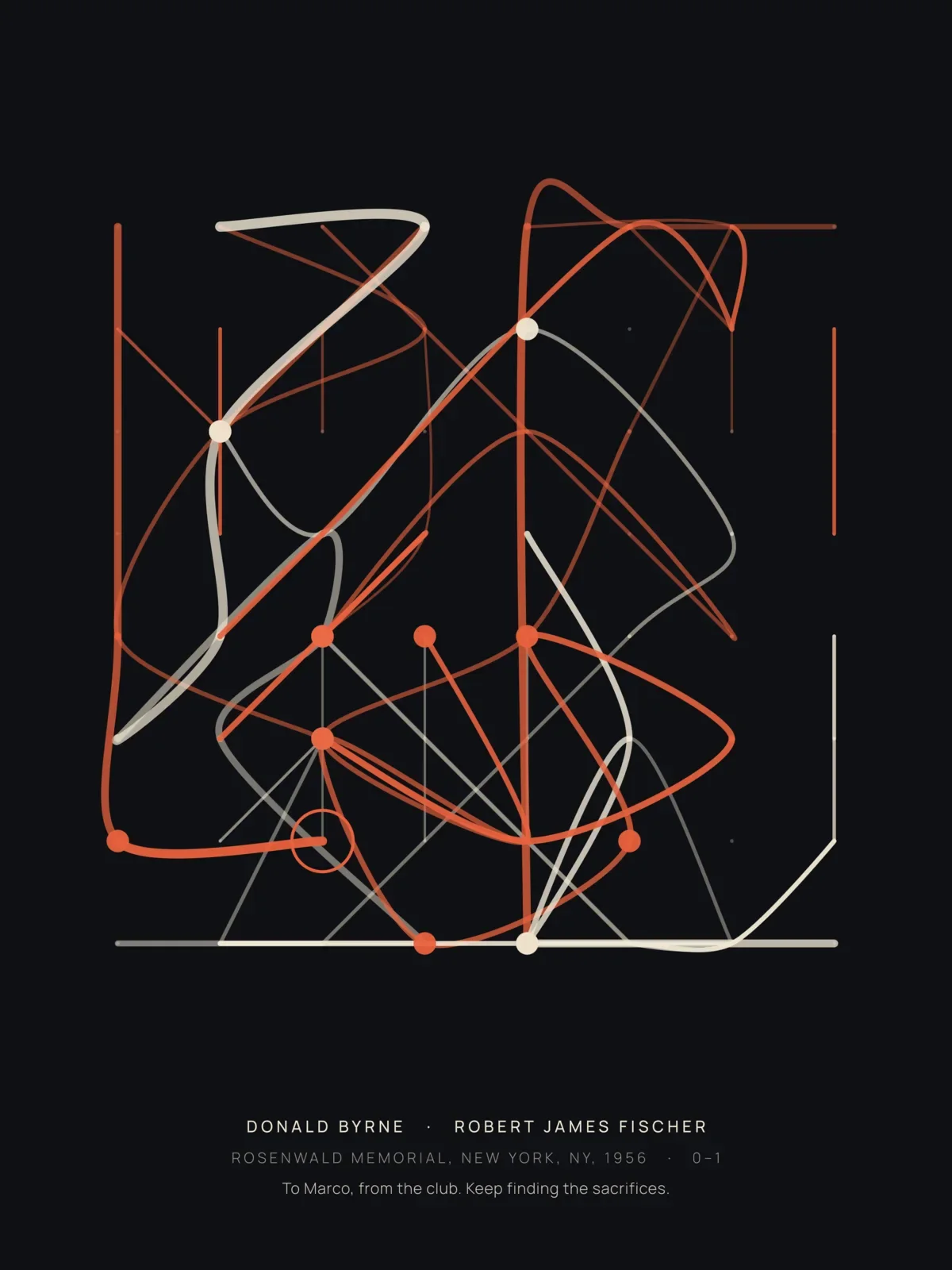
The Game of the Century, in four styles.
Each one is drawn from these 41 moves and nothing else. Choose a style and a colour preset, add a line for the person it is for, and we print it on 200 gsm matte paper.

More games with their own page.
Each one with the story, the move where it turned, the whole game to replay, and the print beside it.
The Opera Game. Swiss, Signal red. 50 × 70 cm, Classic frame in black. €159.