Famous games
Seventeen moves, two noblemen, and an opera nobody watched.
Paul Morphy was twenty-one and had come to the Théâtre-Italien for the music. The Duke of Brunswick and Count Isouard had a chessboard in the box. What followed is the most taught attacking game in chess, and it turns out to be a very good print.

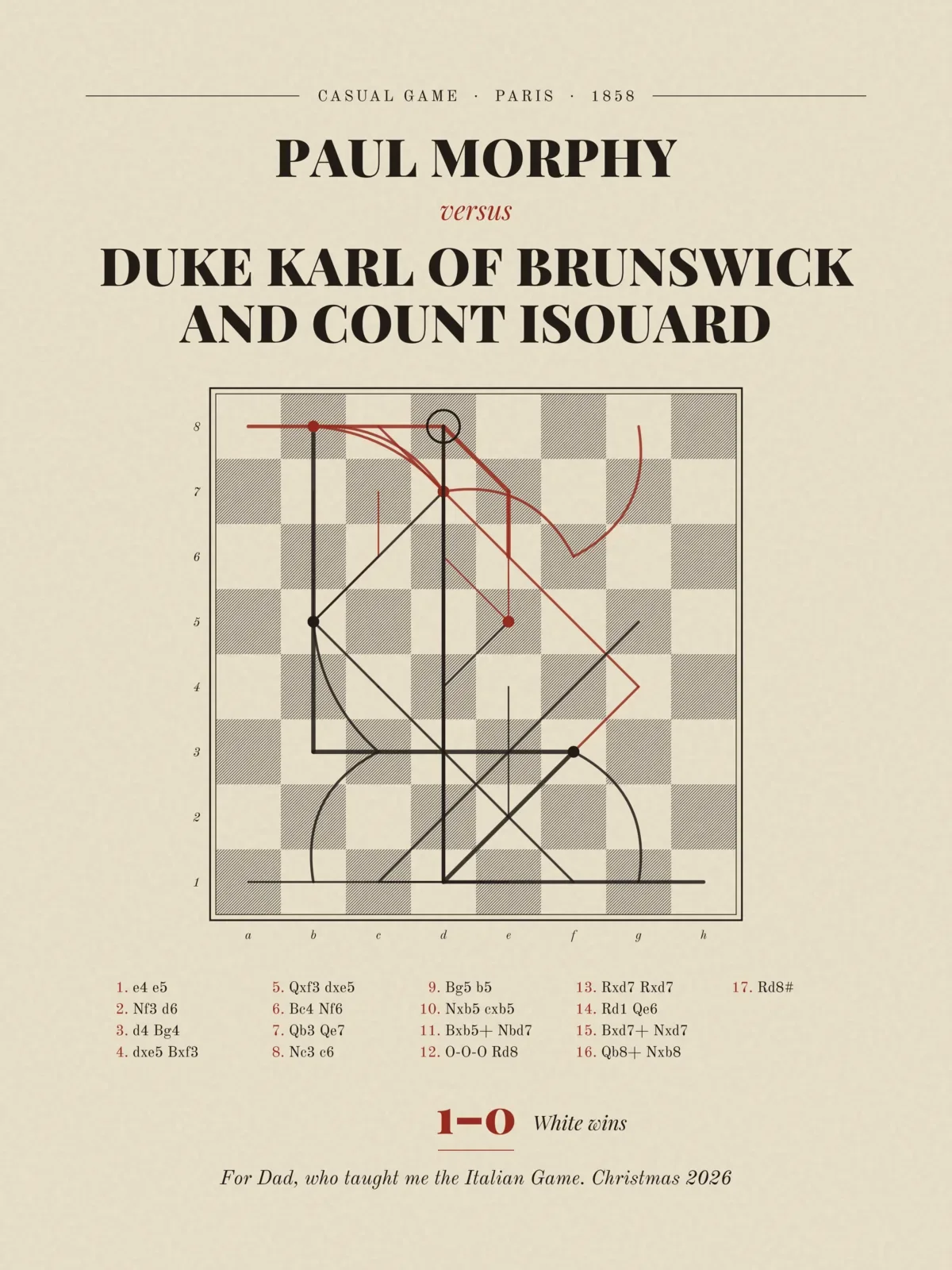
Letterpress, Cream. 50 × 70 cm, Classic frame in black. The whole game is set in notation under the board, the result in oxblood. Unframed €69, framed €159.
The game was played in a box at the opera, with Morphy’s back to the stage. Which opera was on is still argued over: most accounts say Rossini’s Barber of Seville, some say Bellini’s Norma, which the company had played a few weeks earlier. His two opponents consulted on every move and took their time; Morphy, who had come to listen, did not.
After eight ordinary moves the Duke and the Count had a cramped position and not much to do with it. Morphy gave a knight on move ten, then a rook on move thirteen, then on move sixteen his queen. Each gift pulled a defender off a square it needed. The last one, Qb8+, could only be taken by the knight, and when it was, the rook that was still on the board went to d8 with a bishop behind it. Mate.
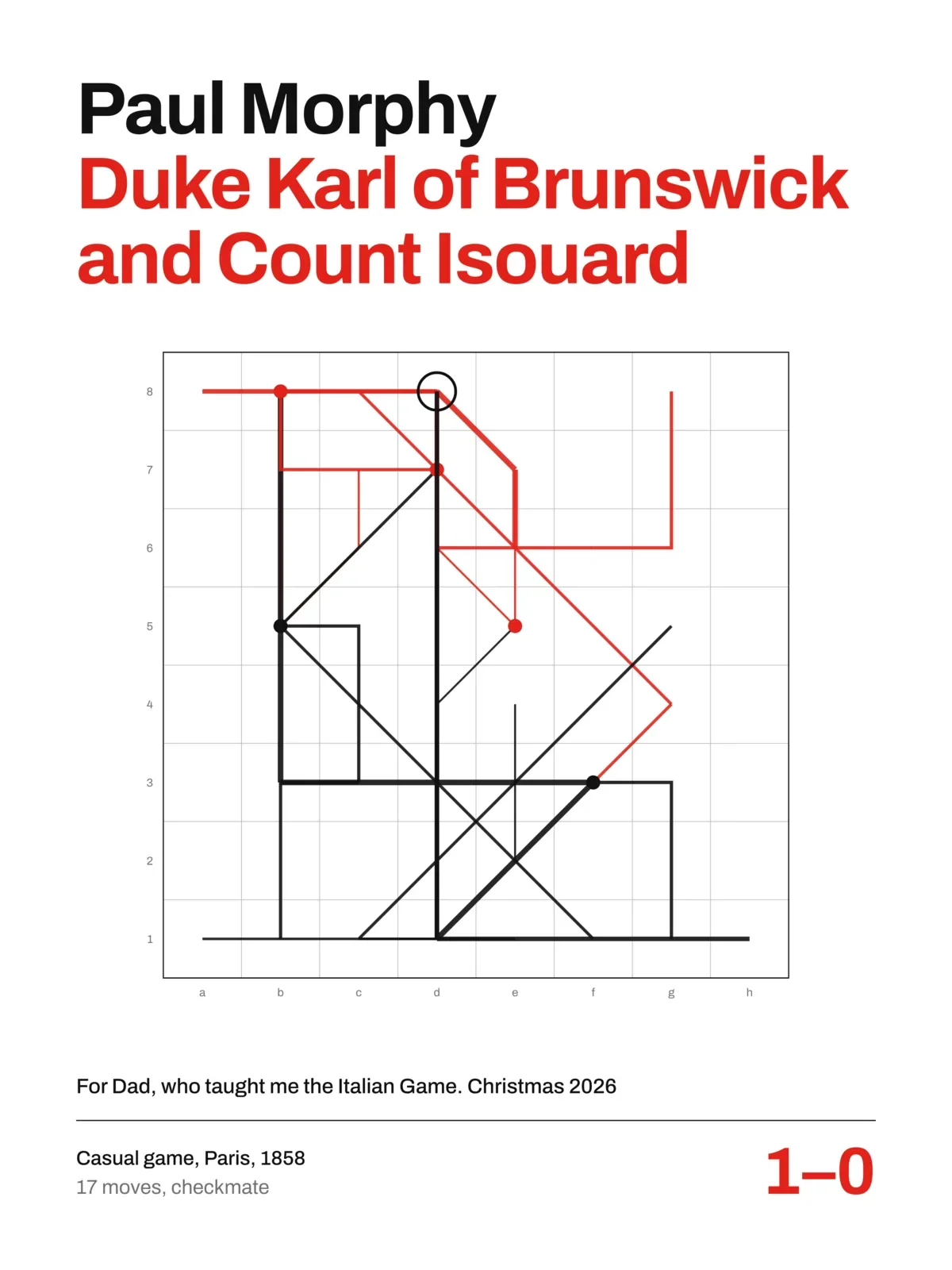
Every piece White owned took part. Nothing was wasted, nothing came back. That is why the game is in every beginner’s book and why, drawn as a set of lines, it looks the way it does: a few long straight strokes converging on one square. On the print you can follow the whole attack with a finger.
A knight, a rook and the queen, given away in seven moves. The mate needed a bishop and the one rook that was left.
The moves
- 1. e4 e5
- 2. Nf3 d6
- 3. d4 Bg4
- 4. dxe5 Bxf3
- 5. Qxf3 dxe5
- 6. Bc4 Nf6
- 7. Qb3 Qe7
- 8. Nc3 c6
- 9. Bg5 b5
- 10. Nxb5 cxb5
- 11. Bxb5+ Nbd7
- 12. O-O-O Rd8
- 13. Rxd7 Rxd7
- 14. Rd1 Qe6
- 15. Bxd7+ Nxd7
- 16. Qb8+ Nxb8
- 17. Rd8#
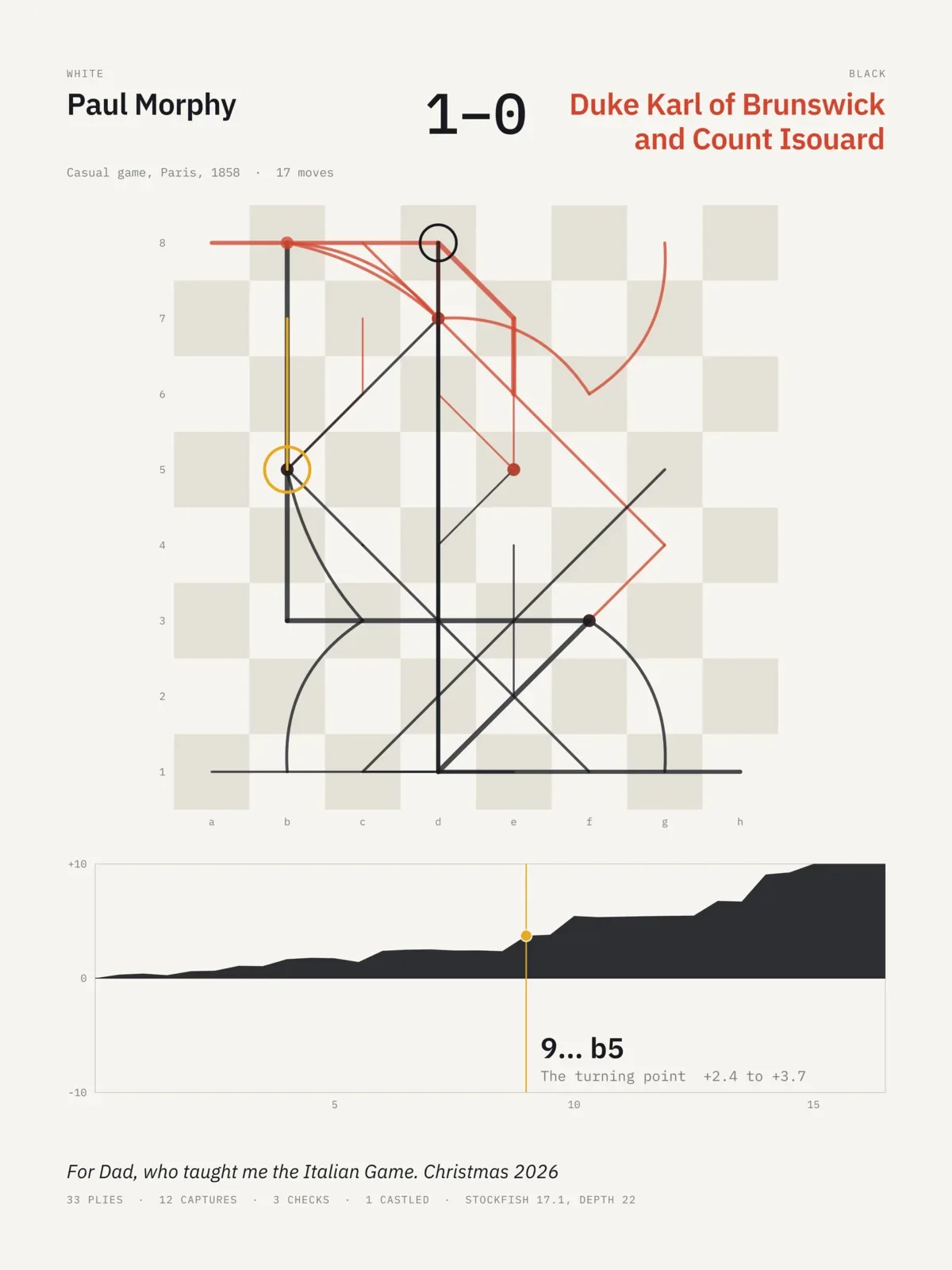
The turning point: 9...b5
The engine marks Black's ninth move as the one after which White's advantage runs away. The pawn push lets the knight land on b5 with check to follow, and every move from here is forced. On the Data story print this is the move named on the chart; in the film it is where the score changes.
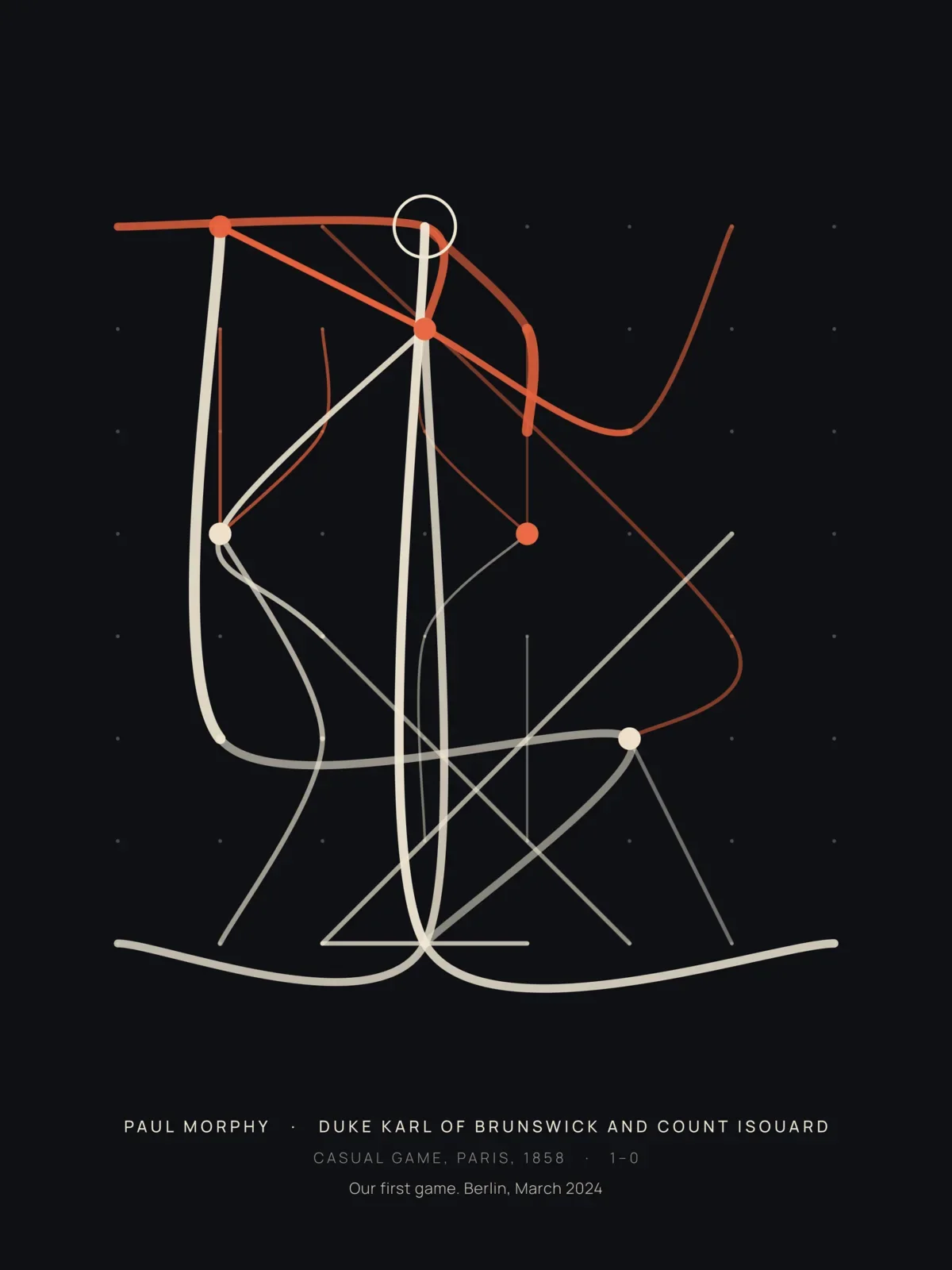
The Opera Game, in four styles.
Each one is drawn from these 17 moves and nothing else. Choose a style and a colour preset, add a line for the person it is for, and we print it on 200 gsm matte paper.

More games with their own page.
Each one with the story, the move where it turned, the whole game to replay, and the print beside it.
Generative, Night. 50 × 70 cm, Classic frame in natural wood. €159.